Careers
All students should leave Lift Ryde excited about their futures. From years 7 to 13, students are inspired to focus on their futures when they leave school.



All students should leave Lift Ryde excited about their futures. From years 7 to 13, students are inspired to focus on their futures when they leave school.

Careers Leader: Joelle Dorman jdorman@liftryde.org
Careers Adviser: Louise Eaton leaton@liftryde.org
At Lift Ryde we believe an excellent curriculum is an important foundation to deliver our mission of an excellent education to every child in every classroom and everyday. Our Careers provision is woven into our curriculum, and is built to enable our students to achieve aspirational futures.
A range of opportunities are open to students as they progress through the school to help them develop their career aspirations. These range from enterprise days, mock interviews, careers fairs, visits to employer sites and work experience. All students have access to an impartial careers advisor and a range of post-16 providers who inform students of the different pathways available to them.
Lift Ryde Unifrog
How to log on - parents/carers and students
It's never too early to start thinking about your career. That's why all students in Years 7-13 have access to the Unifrog platform, designed to support them in making the most informed decisions about their futures. Unifrog has a range of tools that are suitable for all year groups. Each student has their own personal account that provides a wide range of information related to their interests and aspirations. Parents can also share students' learning journeys by accessing Unifrog.
Please use this link to log in to Unifrog.
What students experience
Key Stage 3 students are introduced to careers, explore future pathways and reflect on their own personal attributes. They experience career possibilities through curriculum learning, assemblies, career events and team building activites.
Key Stage 4 students consolidate their understanding of possible pathways post-16 and develop their career management skills. They have opportunities to interact with and experience FE colleges, university life, apprenticeships and employment. They also receive support with applications, interviews and planning.
Sixth Form students are aspirational and well informed about future options, including HE, FE, apprenticeships and employment. All students leave with the ability to make decisions about destinations and future pathways.
They visit university open days, careers fairs and HE fairs, apprenticeship workshops. We also have visits from alumni, university speakers, student finance and employers. Sixth Form students spend one week in a work experience placement.
Click here for our Careers Learning Overview
Our post-16 pathways guide can be found here
If you have any questions about Careers education at Lift Ryde, please contact: mwalsh@liftryde.org

A Level qualifications are more academic in nature and focus on traditional study skills. They usually take two years to complete.
Entry requirements vary according to which Post-16 Provider students wish to apply for and which subjects they wish to study. Typically, students will be expected to have achieved five Grades 9-4 including English and Maths. Many courses will ask students to have achieved a Grade 5 or above in the subject they wish to study.
From 2015, the Government introduced changes to A-Level subjects. These changes mean that the new reformed A-Levels will be ‘linear’, with all assessment undertaken at the end of two years of study.
The subjects that will be linear from 2015 are English Language, English Literature, English Language & Literature, the Sciences, History, Psychology, Art & Design, Business Studies and Computing.
The remaining subjects will continue as before, with students gaining half their marks assessed through the AS qualification in the first year of study. AS Levels are equivalent to half an A Level. Some students gain an AS qualification and then do not complete the second year to achieve an A Level.
Some Post-16 providers will ask students to select 4 A-Level subjects. Some will ask students to select up to 5 A-Level subjects.
Upon successful completion of a Level 3 qualification students will be in a position to go into the workplace or apply for University (Level 4) courses.
Vocational qualifications offer a more practical approach to learning that relates to specific jobs or industries e.g. childcare, business, sport. Unlike A Levels, there are different “Levels” of vocational qualifications.
There are often no formal entry requirements for these courses, which are designed to provide students with essential life and study skills. Entry Level programmes can help prepare students to begin Level 1 Courses.
Level 1 qualifications are equivalent to GCSE 4-1 grades. Students will usually need to have gained 3 and 4 grades in their GCSEs to study a Level 1 programme. Successful completion of Level 1 courses can allow students to progress to Level 2 courses.
Level 2 qualifications are equivalent to GCSE 9-5 grades. Students will usually be expected to have achieved at least four GCSEs at grade D or above to enroll on one of these programmes, although requirements can vary according to which Post-16 Provider students wish to attend. Successful completion of Level 2 courses can allow students to progress to Level 3 courses.
Level 3 vocational qualifications are equivalent to three ‘A’ Levels so students will usually need to have achieved at least five GCSE passes at grade 5 or above to enroll on these programmes. However, requirements can vary according to which Post-16 Provider students wish to attend. Upon successful completion of a Level 3 qualification students will be in a position to go into the workplace or apply for university courses, which are Level 4 and above.
These courses cover Maths, English and ICT (computer skills). Students are often instructed by colleges to complete Functional Skills in addition to their chosen courses if they haven’t gained the relevant GCSE pass grades 9-4.
Apprenticeships allow students to earn while they learn. They combine on-the-job experience with college based study. Apprenticeships are Government-funded programmes.
However, students need to approach work places to arrange apprenticeships because many apprenticeships are not advertised until June / July. Students also need to ensure that the employer has, or is willing to establish, a formal relationship with a college for the college based study element of the Apprenticeship. Apprenticeships can be Level 2, 3 or 4. The entry requirements vary considerably depending of the Level of the qualifications.
T Levels are new technical study programmes that sit alongside apprenticeships and A levels within a reformed skills training system. The introduction of T levels aims to streamline technical education and focuses on developing skills that sit within 15 industry routes. T levels will be level 3 technical study programmes, based on employer-designed standards and content, which will prepare students for highly skilled jobs and enable them to adapt to meet the skills needs of the future. Students achieving T levels will be able to progress to the highest levels of skilled employment or technical education and training at levels 4, 5 and 6. Progression options will include higher and degree level apprenticeships or higher technical education, including technical degrees. Apprenticeships and T levels are on the same set of standards designed by employers and others but there will be a difference in the overall content of each programme to reflect that apprenticeships are mainly delivered in the workplace, and T levels will mainly be delivered in the classroom. Students achieving a T level will have the numeracy, literacy, digital skills and wider transferable skills, attitudes and behaviours needed to succeed in occupations relevant to their chosen route and the wider workplace of the future.
Island Futures, who manage the careers advisory service on the Island, are able to speak to young people directly to offer advice and guidance.
Telephone for an appointment: 01983 823888 or email: island.futures@iow.gov.uk
Information for Isle of Wight College
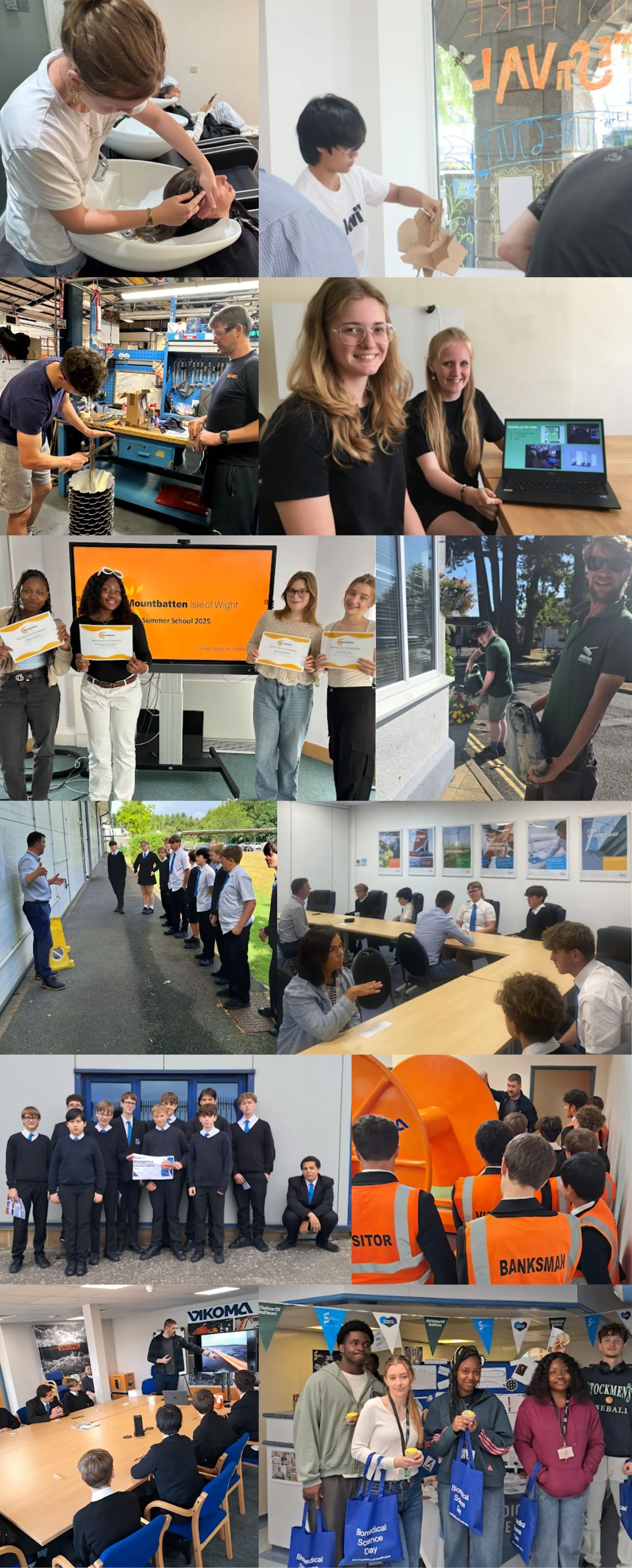
We would always be keen to hear from local employers who would like to share information and opportunities with our young people. We frequently hold specific seminars with individual employers or can invite you into the school to attend a larger event.
Click here to view the Lift Ryde provider access policy
UCAS – Further Education – Sixth form, college and apprenticeships
Find an Apprenticeship – Government website for apprenticeships in England
Informed Choices (Russell Group) – Helps you understand which subjects open up different degrees, particularly at Russell Group universities
National Careers Website – Speak to an adviser by calling 0800 100 900
GCSE Choices and University – Tips to pick the right GCSE subjects
BBC Bitesize Careers – Find advice from people who've found the right path for them
Prospects – Look at different job profiles, search by sector or by job title
Do it – Volunteering website for lots of different industries, not just charities
.webp)


.png)


